|
THE
HISTORY OF ORTHODOXY IN AMERICA
In the 18th Century, the great Orthodox Christian
missionary work which began with Pentecost in Jerusalem, so many
centuries before, finally crossed from the continent of Euro-Asia
into North America. The first missionaries traveled with the explorers
Vitus Bering and Alexei Chirikov, who formally claimed Alaska and
the Aleutian Islands in 1741. For the next fifty years, together
with the exploration and economic development of this new outpost
of the Russian Empire, the first attempts were made to bring the
Orthodox Faith to the natives of that region (the Aleuts, the Athabascan
Indians, the Tlingits, and the Eskimos).
The first formal Orthodox Christian Mission to America arrived
on September 24, 1794, in Kodiak. This Mission consisted of eight
Monks and two Novices, together with ten Alaskan natives who had
been taken to Russia by Gregory Shelikov in 1786. This Mission discovered
on Kodiak Island hundreds of natives who had been taught the rudiments
of the Orthodox Faith, and had been baptized by laymen. Gregory
Shelikov, one of the founders of what was to become later the Russian-American
Company, had himself baptized about two hundred Aleuts on Kodiak
Island.
The American Mission, headed by Archimandrite Joasaph, immediately
began the work of establishing the Church in Kodiak and the Islands
and later on the mainland of Alaska. Despite great difficulties,
this Mission was very successful, for virtually all the remaining
natives of Kodiak Island were baptized in just three years. During
this period, one of the missionaries, Hieromonk Juvenaly, was martyred
at Lake Iliamna by natives.
In 1798, Archimandrite Joasaph returned to Irkutsk in Siberia and
was consecrated on April 10, 1899, Bishop of Kodiak, the first Bishop
for America, but he and his entourage, including Hieromonk Makary
and Hierodeacon Stephen of the original Mission, drowned somewhere
between Unalaska and Kodiak Island. Though the American Mission
was now reduced to half of its original number, it continued its
work. Notable was the great spiritual and missionary work of the
Monks Herman and Joasaph. Not only did they instruct the natives
in spiritual and religious matters, but they also taught them practical,
secular subjects, such as mathematics, carpentry, agriculture, as
well as animal husbandry.
In 1824, with the arrival of the Missionary Priest John Veniaminov
in Unalaska, a new impetus was added to the missionary work already
done. The original missionaries had been replaced by others, so
that by the time of the arrival of Father John, only the Monk Herman,
now retired to Spruce Island, was left of the original American
Mission. He died on December 13, 1837, and on August 9, 1970, he
was canonized as the first Saint of the Orthodox Church in America.
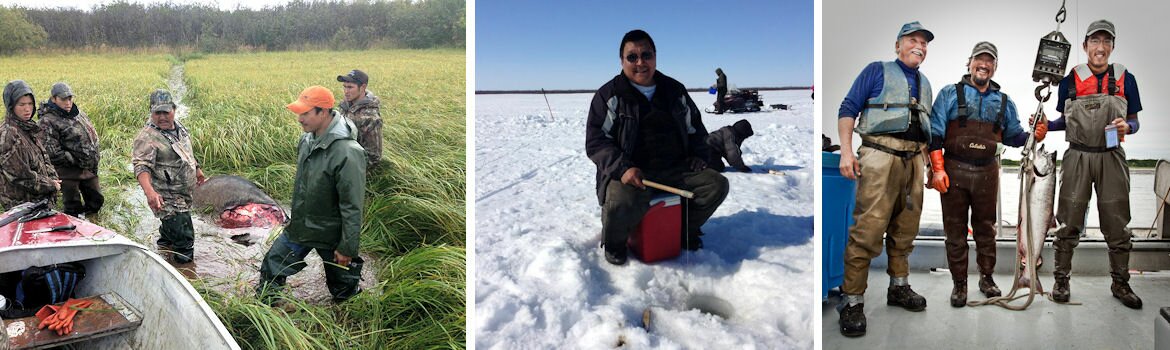
The Orthodox Church in Alaska is a Native institution - the first
in America to receive the gospel of Jesus Christ. Through the efforts
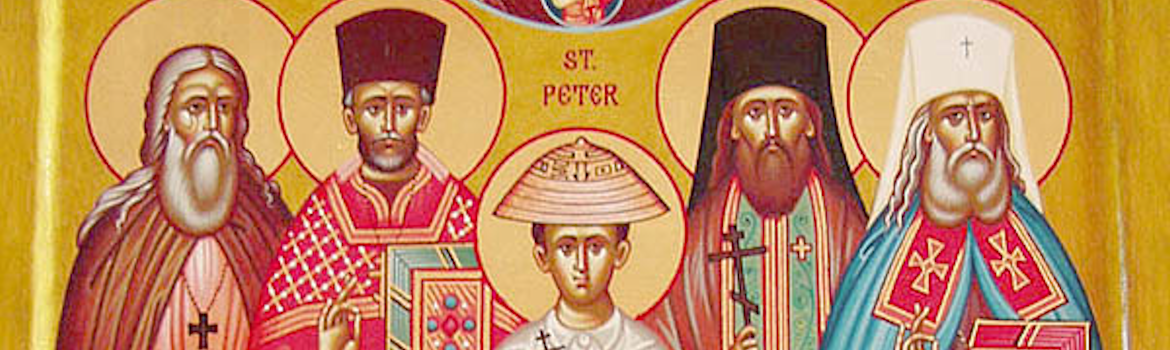
of our Russian missionaries (St. Herman of Alaska, St. Innocent,
St. Yakov, St. Juvenaly, and Peter the Aleut) beginning in 1794,
the faithful of Alaska possess a uniquely Orthodox heritage resulting
in deep commitment to and love for the One Holy Catholic and Apostolic
Church. Up until the time of the Russian Revolution and civil War,
the Alaska Mission was financially and spiritually supported by
Russia. The church in the New World was suddenly left without financial
support or administrative guidance. All jurisdictions of Orthodox
Christians (Antiochian, Greek, Serbian, Russian) were under the
Patriarchate of Moscow. Orthodox Patriarchates from other areas
of the world responded to the floundering Orthodox in America by
sending priests into the U.S. to provide guidance and support to
their various ethnic communities. However, there was no one to send
into Alaska since the Native church was of the Russian Mission.
The growth and survival of the Orthodox Church in Alaska depended
almost exclusively on local commitment and initiative. Left without
any well-funded, centralized administration, without any coordinated
plan for maintenance or expansion, the church not only continued
but also increased. Regional conferences and lay preachers worked
with Native clergy to propagate the faith - village by village.
However, over the decades, incredible hardships have fallen upon
the Orthodox Christians in this great and Holy Land. Following America's
purchase of Alaska in 1867, the U.S. Government attempted to obliterate
the native Alaskan culture through severe, aggressive assimilation
policies. Since the late 19th century, confident they knew what
was best for Native Alaskans, federal officials removed adolescent
children from their homes and communities, transporting them to
district boarding schools for instruction in the ways of modern
America - "the Anglo Saxon frame of mind" and "These
Natives have embraced the wrong kind of Christianity" - an
Ethnic Cleansing, denying them all traditions of the Orthodox faith
inclusive of burial.
Following the Japanese bombing and invasion of the Aleutian Islands,
June 1942,the Aleut Natives - Orthodox Christians - became the first
Americans since 1812 to know the fear of foreign invasion on their
own land. World War II brought relocation, internment and a scorched
earth policy by the U.S. Government to native communities of the
Aleutian and Pribolof Islands. The American relocation and Japanese
prison camps resulted in 60% of the natives dying from disease and
malnutrition. American troops garrisoned the islands for nearly
2 years - using Orthodox Churches for target practice, decimating
holy objects, vandalizing and looting native homes, churches and
community property. The work of reconstruction was mammoth, particularly
when it was thrust upon people who had been impoverished by the
war.
What enabled Alaska Native peoples to endure and survive was their
essential spirituality. Tragically, this inner strength was undermined
in the 1960's when the Great Society discovered that rural Alaska
was, per capita, the most impoverished region of the country. Although
the Natives had successfully managed to survive in the Arctic for
centuries, they were suddenly and unexpectedly inundated with non-reciprocal
institutional assistance - welfare checks, food stamps, and an entire
bureaucracy to sustain and perpetuate these programs. Then the government
decided they must educate the Native Alaskan peoples. The ultimate
goal of dominant culture, but at the lowest level. The "educated"
person was caught between two worlds, fitting comfortably into neither.

An Institution of the Russian Orthodox Diocese
of Alaska, Orthodox Church in America
2421 Perry St. • Wichita, KS
67204
316-832-0734
info@outreachalaska.org
|